
- Home
- Blog
- Forecast and Price Predictions
- Turkish Lira Forecast & Price Predictions 2026 and Beyond: Banks and Agencies Expect Continued TRY Depreciation
Turkish Lira Forecast & Price Predictions 2026 and Beyond: Banks and Agencies Expect Continued TRY Depreciation
The Central Bank of the Republic of Turkey (CBRT) enters 2026 with a firmly restrictive yet gradually recalibrated monetary stance, following an extended tightening cycle aimed at restoring price stability. After inflation peaked above 75% in mid-2024, disinflation gained momentum through 2025, allowing cautious monetary easing while maintaining tight real financial conditions. Official CBRT projections indicate that annual inflation could decline toward the mid-teens by the end of 2026, although upside risks remain, particularly from services inflation and wage pressures.
CBRT officials continue to stress that future interest-rate decisions will be strictly data-dependent and conditional on sustained disinflation. While policy rates are expected to trend lower in 2026 compared with peak levels, the central bank’s priority remains preventing renewed pressure on the currency. This more orthodox policy framework underpins the Turkish Lira outlook, emphasizing inflation targeting, macro-prudential discipline, and efforts to reduce dollarization.
Within this macro backdrop, Turkish Lira price predictions for 2026 suggest a scenario of relative stabilization rather than sharp appreciation. Most baseline Turkish Lira Forecast models point to a controlled, gradual depreciation of the TRY, broadly aligned with inflation differentials and the CBRT’s commitment to financial stability, rather than abrupt exchange-rate adjustments.
Turkish Lira Forecast & Price Prediction 2026 – Summary
- Turkish Lira forecast 2026 (Fundamental outlook): In 2026, the Turkish Lira outlook will be shaped primarily by disinflation progress and the Central Bank of Türkiye’s cautious monetary stance. Official CBRT projections point to inflation declining toward the 13–19% range by year-end 2026, while policy rates are expected to remain restrictive despite gradual easing. Under this framework, fundamental models suggest USD/TRY is likely to trade in the 42–46 range during 2026, reflecting controlled depreciation aligned with inflation differentials rather than abrupt currency moves.
- Turkish Lira price prediction 2026 (Macro-driven): From a macroeconomic perspective, the CBRT’s emphasis on data-dependent easing and tight financial conditions should limit excessive volatility. Assuming policy rates remain elevated relative to inflation and no major fiscal slippage occurs, analysts estimate the TRY could depreciate by roughly 8–12% over 2026. This places potential year-end levels near the upper-40s in less favorable scenarios, while stronger capital inflows could keep USD/TRY closer to the low-40s.
- Turkish Lira forecast for the next 5 years: Looking further ahead, Turkish Lira forecast models based on artificial intelligence remain structurally cautious. According to algorithm-driven projections from LongForecast, Wallet Investor, and Trading Economics, USD/TRY is expected to follow a steady upward trajectory, reaching approximately 55–60 by 2028 and 65–75 by 2030 under baseline scenarios. These price predictions assume gradual disinflation and policy continuity, with sharper moves generally associated with renewed inflationary pressures or shifts away from orthodox monetary policy.
With NAGA.com, you can trade CFDs on USD/TRY and EUR/TRY with low fees, tight spreads, and easy-to-use interface.
High-interest-rate currencies like the Turkish lira are very attractive to those who are aiming for swap points in forex trading. However, for beginners, trading for Turkish lira swap points carries a great deal of risk.
Follow the USD/TRY, EUR/TRY, and GBP/TRY price charts for live data, and read our latest Turkish Lira forecast and price predictions for 2026 and beyond. Key pivot points and support and resistance levels provide further insights to help you make informed trading decisions.
Fundamental Turkish Lira Forecast 2026
The Turkish Lira forecast for 2026 reflects the complex interplay of monetary policy, inflation dynamics, and structural economic challenges in Türkiye. Following the CBRT’s recent interest rate cuts to 45%, further gradual reductions are expected, contingent on declining inflation, which is projected to ease to 25–30% by year-end. External factors—including strong tourism inflows, energy import costs, and global financial conditions—will influence the lira’s path. Overall, fundamentals suggest a controlled depreciation against the USD, with USD/TRY likely trading in the 48–55 range in 2026, highlighting the balance between policy efforts, economic constraints, and external pressures.
Monetary Policy Under Scrutiny
The CBRT’s monetary easing cycle began with a 250 basis point cut interest rates to 45%, marking a pivot from previous aggressive tightening. Governor Fatih Karahan emphasized the need to balance inflation control with growth, while Deputy Governor Osman Akcay warned that rapid rate reductions could destabilize markets. The pace of future cuts will depend on inflation trends and external economic conditions. Analysts from Standard & Poor’s and Fitch Ratings note that cautious, incremental adjustments are essential to maintain lira stability while supporting economic recovery.
Inflation Trends and Economic Slowdown
Annual inflation has declined from 75% in mid-2024 to 44.38% in December 2024, but underlying price pressures remain, particularly in services and administered energy prices, such as a 30% increase in natural gas costs. Real depreciation of the lira has moderated inflation somewhat, yet tight financial conditions are likely to trigger an economic slowdown in early 2026. Analysts predict GDP growth of around 3%, with persistent inflation risks constraining household consumption and investment.
Current Account Improvement and External Pressures
Turkey’s current account deficit has narrowed due to strong export performance and lower import demand. Tourism revenues, which reached record highs in 2024, are expected to continue supporting foreign currency inflows in 2026. CBRT reserves could benefit from periodic surpluses, yet energy import dependency remains a vulnerability. A favorable decline in global energy prices could further ease the current account balance and support inflation moderation.
Tourism and Domestic Demand
Tourism remains a bright spot for 2026, with visitor projections supporting FX inflows and easing USD/TRY pressures. However, domestic policies, including potential minimum wage adjustments, may increase inflationary pressures. Effective fiscal management and targeted subsidies will be critical to prevent these measures from destabilizing the lira.
Long-Term Turkish Lira Forecast – 2026 Implications for USD/TRY
Agencies and AI-based models, including LongForecast, WalletInvestor, and Trading Economics, projects a gradual depreciation of the lira over 2026. USD/TRY is likely to trade in the 48–55 range, reflecting ongoing monetary easing, inflation moderation, and structural constraints. Analysts remain cautious on the long-term outlook, highlighting that political and economic uncertainties could push USD/TRY as high as 90–95 by 2030. Turkey’s ability to maintain fiscal discipline, stabilize inflation, and leverage tourism and export growth will be key determinants of the lira’s trajectory.
Turkish Economy Outlook and Forecast
Turkey’s economic outlook for 2026 reflects a challenging yet cautiously improving trajectory as policymakers prioritize disinflation, fiscal discipline, and external stability. Annual inflation is projected to ease significantly, with interim targets set at around 16% for the end of 2026, down from much higher levels in recent years. Governor Fatih Karahan emphasized that the central bank stands ready to tighten policy again if inflation deviates significantly from its goals, highlighting data-driven decision-making and communication transparency.
Monetary policy is expected to remain relatively restrictive even as gradual easing continues. The policy rate could decline to around 25.5% by year-end 2026, supported by moderating inflation and stabilization in financial conditions, while growth is forecast at about 3.5% for 2026.
The structural balance of external trade is also evolving. Turkey’s current account deficit is broadly expected to narrow as export performance improves and imports stabilize, with projections suggesting a deficit of around ‑1.3% of GDP in 2026. Amid ongoing fiscal tightening, this narrowing helps reduce external vulnerabilities, although dependency on energy imports remains a key risk.
Labor markets are gradually stabilizing, with unemployment projected to ease modestly through 2026 as economic activity strengthens. Tourism — a significant source of foreign exchange — continues to be an important support, with revenues expected to remain strong and contribute positively to the balance of payments.
Despite these improvements, inflation inertia, wage pressures, and geopolitical uncertainty continue to pose risks to the economy. Export competitiveness remains sensitive to currency movements and global demand. Nonetheless, 2026 is viewed as a critical year for Turkey’s economic program, emphasizing the importance of maintaining tight policy credibility, managing external financing needs, and pursuing structural reforms to support medium-term stability and growth.
Turkish Lira Forecast - Technical Outlook
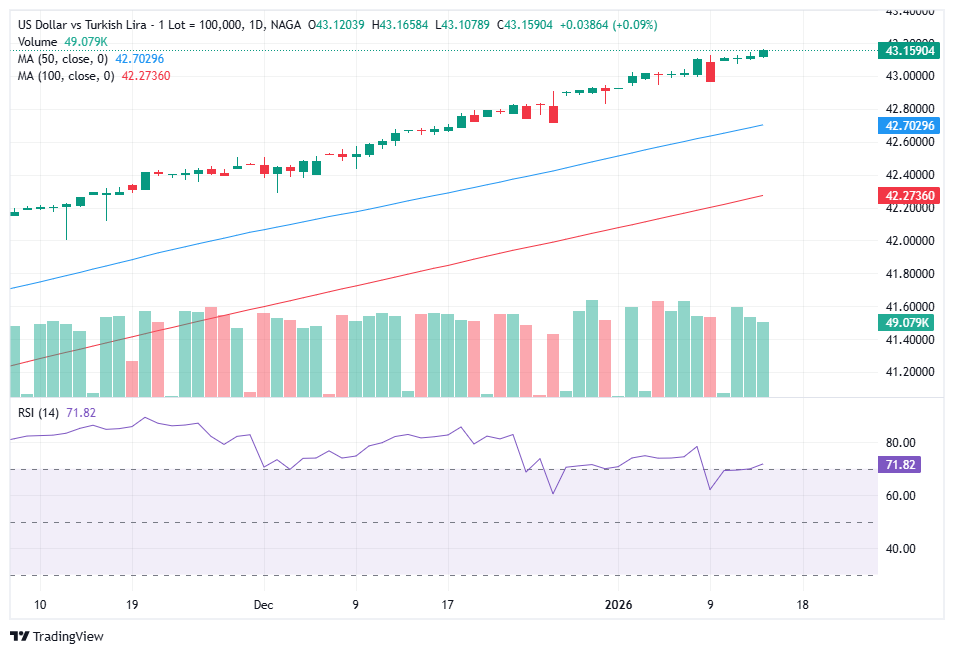
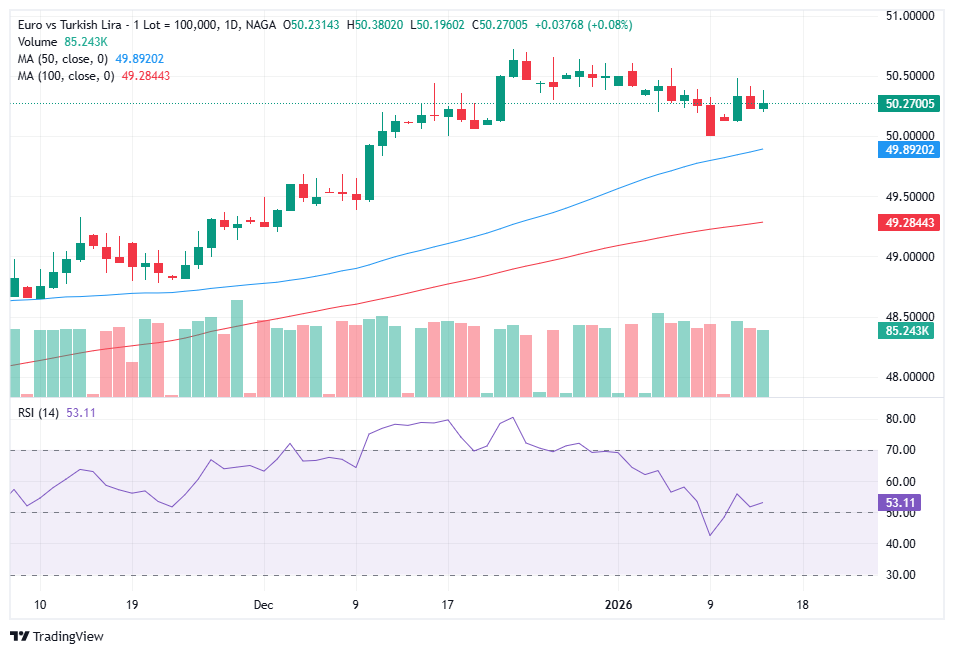
The Turkish Lira continues to face significant pressure against major currencies, reaching new record lows amid ongoing economic and geopolitical challenges. The USD/TRY recently surged past 43.16, reflecting persistent weakness of the Lira against the U.S. Dollar, while the EUR/TRY trades near 50.26, supported by a strong Euro and continued structural vulnerabilities in the Turkish macroeconomic indicators. These movements reflect long-term technical trends, with momentum indicators highlighting sustained bullish pressure on USD/TRY and EUR/TRY. Key support and resistance levels remain essential for monitoring potential pullbacks and trend continuation over the medium to long term.
US Dollar to Turkish Lira Forecast
The USD/TRY pair continues its strong upward trajectory, reflecting ongoing macroeconomic pressures and structural weakness in the Turkish Lira. The exchange rate currently trades near 43.16 TRY per USD, maintaining the broader depreciation trend observed over the past years. This persistent bullish movement highlights the Lira's vulnerability against the U.S. Dollar in 2026.
Technical indicators show robust momentum, though daily charts suggest short-term caution. The daily Relative Strength Index (RSI) is at 71.82, indicating that the pair is entering overbought territory and may face temporary pullbacks or consolidation before continuing the long-term uptrend. Long-term Exponential Moving Averages (50‑day and 100‑day EMAs) remain upward-sloping, confirming the structural strength of the USD against the Lira.
Note: Past performance is not a reliable indicator of future results. All historical data, including but not limited to returns, volatility, and other performance metrics, should not be construed as a guarantee of future performance.
Key support levels to watch are 42.50, 41.80, and 40.90, which may provide floors during corrective phases. Resistance levels lie around 44.00, 44.75, and 45.50, representing critical points where bullish momentum could accelerate if broken decisively. While the long-term trend remains bullish, traders should consider short-term RSI caution signals for potential pullbacks.
Euro to Turkish Lira Forecast
The EUR/TRY pair continues to trend higher, with the Turkish Lira under persistent depreciation pressure. The exchange rate currently hovers near 50.26 TRY per Euro, reflecting structural weakness in the Lira relative to major currencies.
From a technical standpoint, long-term EMAs (50‑day and 100‑day) indicate continued upward bias, while the long-term RSI remains above neutral levels, supporting the ongoing trend. These signals suggest that the Euro is likely to maintain its strength against the Lira, barring significant macroeconomic or geopolitical shifts.
Note: Past performance is not a reliable indicator of future results. All historical data, including but not limited to returns, volatility, and other performance metrics, should not be construed as a guarantee of future performance.
Key support levels are 49.20, 48.50, and 47.80, while resistance is found at 51.00, 51.75, and 52.50. Breaching resistance levels could trigger further gains, whereas testing support may lead to short-term consolidation.
Turkish Lira Forecast 2026 According to Leading Banks and Rating Agencies
The Turkish Lira (TRY) continues to face depreciation pressures amid persistent inflation and structural economic imbalances. Major financial institutions and rating agencies have issued updated forecasts for the Lira’s performance against the U.S. Dollar (USD) in 2026, with most projecting continued weakness under prevailing macroeconomic conditions.
S&P Global Ratings – Cautious Outlook for TRY
S&P Global projects that Türkiye’s inflation will remain elevated in 2026 despite a downward trend, with annual inflation expected to settle in the high teens as disinflation progresses. Although inflation dynamics and reserve levels show some improvement, S&P emphasizes that ongoing price pressures — particularly in core and food prices — may limit the scope for meaningful Lira stabilization unless structural reforms and monetary policy credibility improve.
ING – Controlled Depreciation Scenario
ING’s updated outlook anticipates inflation easing toward approximately 22% by the end of 2026, alongside a gradual reduction in the policy interest rate toward the high‑20s as disinflation advances. Under this scenario, ING projects the USD/TRY exchange rate could reach around 51.0 by year‑end 2026, reflecting continued but orderly Lira depreciation amid persistent external imbalances and inflation differentials.
Goldman Sachs – Moderate Strengthening Scenario
Goldman Sachs projects that the USD/TRY pair may rise toward roughly 45.0 in 2026, driven by structural depreciation pressures and expectations of continued currency adjustment. Their analysis highlights that sustained inflation differentials and macroeconomic uncertainties could keep upward pressure on the exchange rate throughout the year.
Morgan Stanley – Gradual Depreciation Path
Morgan Stanley’s updated forecast sees the USD/TRY exchange rate approaching around 44.0 by late 2026, indicating ongoing currency weakness. Their outlook points to structural challenges, including delayed recovery dynamics and inflation policy uncertainties, as key drivers of the Lira’s continued depreciation.
JPMorgan – Inflation and Policy Risks
JPMorgan’s research suggests that elevated inflation pressures and slower monetary tightening may maintain depreciation momentum for the Lira. Their analysis implies that the policy rate could end 2026 near 30.5%, with inflation remaining relatively elevated, reinforcing downward pressure on the Turkish Lira against the USD throughout the year.
Deutsche Bank – Bearish Medium‑Term Outlook
Deutsche Bank projects the USD/TRY exchange rate to reach around 52.0 by the end of 2026, signaling continued depreciation pressure on the Turkish Lira. The bank forecasts inflation in 2026 at approximately 23.8% and anticipates that carry trade dynamics may weaken, reducing the attractiveness of Turkish assets and supporting a higher USD/TRY trajectory.
Turkish Lira Forecast 2026 Comparison Table
Institution USD/TRY End-2026 Forecast Inflation Forecast Key Outlook S&P Global Ratings ~47.0 High teens (~15-19%) Cautious; needs structural reforms ING ~51.0 ~22% Controlled depreciation Goldman Sachs ~45.0 Not specified Moderate strengthening pressures Morgan Stanley ~44.0 Not specified Gradual depreciation path JPMorgan ~48.0 ~32% end-2025, elevated into 2026 Policy risks, sustained pressure Deutsche Bank ~52.0 ~23.8% Bearish; weakening carry trade
Turkish Lira Price Predictions from AI-based Websites
The Turkish Lira (TRY) continues to face depreciation pressures amid persistent inflation, external imbalances, and structural economic challenges. AI-driven platforms and algorithmic forecasting websites, including LongForecast.com, WalletInvestor.com, CoinCodex, and TradingEconomics.com, provide a quantitative outlook on the TRY’s performance against major currencies such as the USD, EUR, and GBP. These forecasts incorporate historical trends, technical indicators, and macroeconomic data to estimate potential price movements for 2026 and beyond, offering investors and traders a structured view of likely currency trajectories under current economic conditions.
USD/TRY Forecast – Turkish Lira vs U.S. Dollar
The USD/TRY pair is projected to continue its long-term upward trend, reflecting persistent depreciation pressures on the Turkish Lira. According to AI-driven forecasts from LongForecast.com, WalletInvestor.com, and TradingEconomics.com, the USD/TRY could reach around 52.6 by December 2026, with monthly averages ranging between 51.8 and 53.4. This outlook suggests a continued weakening of the Lira against the U.S. Dollar, driven by structural imbalances, inflation differentials, and ongoing monetary adjustments in Türkiye.
LongForecast.com
Algorithmic projections from LongForecast.com indicate a continued depreciation of the Turkish Lira against the U.S. Dollar through 2026–2030. For 2026, the USD/TRY pair is forecast to reach approximately 50.94 Lira by December 2026, up from around 43.37 at the start of the year. The model continues to show rising exchange rates into 2027, with the pair projected near 58.92 by December 2027, and a longer‑term trend toward significantly higher levels, including an average near 94.30 by early 2030. These projections reflect trend‑following patterns and historical volatility embedded in LongForecast’s methodology.
WalletInvestor.com
WalletInvestor’s AI‑based forex forecast also suggests a notable weakening of the Turkish Lira over the medium to long term. As of early 2026, the USD/TRY spot rate is approximately 43.18 Lira, and the model anticipates a continued upward trajectory, with long‑term projections indicating the pair could reach roughly 82.44 by early 2031, implying substantial depreciation pressure over the next several years. This forecast underscores the algorithm’s interpretation of prevailing macro trends remaining broadly intact.
TradingEconomics.com
TradingEconomics employs global macro models and consensus forecasts, reflecting a mild depreciation trend for the Lira. Their models estimate the USD/TRY rate to rise modestly over the short term, with projections placing the pair slightly higher than current levels of around 43.15, and indicating a gradual weakening through 2026 as market factors and monetary policy dynamics evolve.
CoinCodex
According to CoinCodex’s AI‑enhanced short‑term forecast, the USD/TRY exchange rate is expected to increase modestly from around 43.17 to about 43.55, reflecting a bullish sentiment driven by technical indicators such as moving averages and RSI levels. While this projection is shorter‑term than others, it reinforces the broader trend seen across AI forecasts of continued Turkish Lira depreciation against the U.S. Dollar.
EUR/TRY Forecast – Turkish Lira vs Euro
The EUR/TRY exchange rate is expected to rise steadily, signaling further depreciation of the Turkish Lira against the Euro. LongForecast.com projects the EUR/TRY to reach 53.2 by the end of 2026, with highs near 54.5 and lows around 52.9. WalletInvestor.com anticipates a similar trajectory, reflecting an overall five-year trend toward 79.8 by 2030. These projections highlight continued Lira vulnerability amid Euro strength and mixed Turkish economic indicators, emphasizing the importance of monitoring key support and resistance levels.
LongForecast.com
LongForecast.com’s algorithmic model indicates a sustained weakening trend for the Turkish Lira against the Euro over the medium term. In 2026, the EUR/TRY pair is forecast to rise from roughly ~51.95 Liras in April to around ~59.34 Liras by December 2026, showing continued depreciation pressure. The model projects the pair to trend higher into 2027, with forecasts near ~60.52–64.85 Liras by year’s end and further gains into 2028–2030, underlining a long‑term upward bias in EUR/TRY.
WalletInvestor.com
WalletInvestor’s AI‑enhanced forex forecast suggests EUR/TRY may continue its ascent through 2026, with monthly projections indicating gradual increases from ~50.43 at the start of the year to above ~53–54 by mid‑year. Over the long term, the model sees the Euro strengthening notably against the Turkish Lira, with projections approaching the ~96.95 range by 2031, reflecting substantial weakening of TRY versus EUR in the next several years.
TradingEconomics.com
According to TradingEconomics, the EUR/TRY exchange rate is currently trading around 50.26 in early 2026, reflecting continued weakness in the Turkish Lira against the Euro. The platform’s global macro models and market consensus suggest that the pair is likely to remain elevated in the near to medium term, supported by persistent inflation differentials and cautious monetary conditions in Türkiye. While TradingEconomics does not provide explicit long-term numeric forecasts for 2026–2030, its outlook implies ongoing upside pressure on EUR/TRY as long as structural economic challenges and external imbalances persist.
CoinCodex
CoinCodex’s short‑term and medium‑term AI‑informed forecast shows the EUR/TRY rate around ~50.26–50.40, with a bullish technical sentiment in early 2026 and prices expected to rise modestly over coming months. Technical indicators (e.g., moving averages, RSI) support a near‑term upward trend in the pair, suggesting continued Euro strength relative to the Turkish Lira as market participants respond to trend signals and sentiment shifts.
GBP/TRY Forecast – Turkish Lira vs British Pound
The GBP/TRY pair is forecasted to climb, showing the Lira’s ongoing depreciation against the British Pound. According to LongForecast.com, the exchange rate may reach 68.0 by December 2026, with highs near 69.2 and lows around 67.8. Other AI-based projections, including 30rates.com, suggest similar growth, indicating persistent Lira weakness driven by inflation, trade imbalances, and external economic pressures. This trend underscores the need for traders and investors to closely watch market conditions and macroeconomic signals affecting the Turkish Lira.
LongForecast.com
According to LongForecast.com’s algorithmic projections, the GBP/TRY exchange rate is expected to trend upward throughout 2026. The model forecasts GBP/TRY opening near 57.84 Liras at the start of the year, rising to around 69.11 Liras by December 2026, reflecting continued depreciation of the Turkish Lira against the British Pound under persistent macroeconomic pressures. The longer‑term trajectory suggests further gains in 2027 and beyond, with the rate projected above 78.00 Liras by December 2027, highlighting a sustained trend of Lira weakness in the medium term.
WalletInvestor.com
WalletInvestor’s AI‑based forecast also points to an upward trend for GBP/TRY. As of early 2026, the pair stands near 57.78 Liras per Pound, and the model projects the rate rising toward approximately 68.96 within the next year, with even more pronounced distancing over a five‑year horizon reaching around 112.80 Liras, implying significant long‑term depreciation of the Turkish Lira versus the Pound.
TradingEconomics.com
GBP/TRY is anticipated to continue a slow but persistent upward trajectory over the next five years. Beginning near 53.40 in early 2026, the Lira may trade in the range of 52.80–54.10 initially. Year-end projections show a gradual increase: 54.50–55.20 in 2026, 56.00–57.00 in 2027, 58.00–59.50 in 2028, 60.00–61.50 in 2029, and 62.00–63.50 by 2030, reflecting the British Pound’s relative stability and the ongoing structural and inflationary pressures on the Turkish Lira.
CoinCodex
CoinCodex’s technical outlook indicates a gradual increase in the GBP/TRY rate through 2026. While short‑term forecasts suggest minor fluctuations around the 57.70–58.50 Lira range, monthly average projections show the pair strengthening, with averages reaching ~62.65 Liras and higher toward year‑end as trend indicators (such as moving averages and RSI) continue signaling bullish momentum for the Pound against the Turkish Lira.
Note: When looking for Turkish lira future predictions, it’s important to bear in mind that analysts’ forecasts can be wrong. Analysts’ expectations are based on making a fundamental and technical study of the currency pair’s performance. However, past performance is not a guarantee of future results.
Do your own research and always remember your decision to trade depends on your attitude to risk, your expertise in this market, the spread of your portfolio and how comfortable you feel about losing money. Never trade more money than you can afford to lose.
Trading the Turkish Lira
A popular way to trade Turkish Lira on the foreign exchange market is through CFDs.
A forex CFD is a contract in which you agree to exchange the difference in the price of a currency pair from when you open your position to when you close it. Open a long position, and if the forex position increases in price, you’ll make a profit. If it drops in price, you’ll make a loss. Open a short position, and the opposite is true.
Forex is just one of the markets you can trade using CFDs.
Our trading platforms can provide you with a smart and fast way to trade forex. You can trade via the NAGA.com platforms in:
- Your web browser
- One of our mobile apps
Each of our forex trading platforms can be personalized to suit your trading style and preferences, with personalized alerts, interactive charts, and risk management tools.
Trading a USD/TRY CFD
USD/TRY has a Sell price of 43.10 and a buy price of 43.16. You think the Turkish Lira will lose value against the US dollar because the Central Bank of Turkey might cut interest rates, so you decide to buy 0,5 standard lots at 43.16.
Each contract is equal to 100,000 of the base currency of the pair. In this case, selling a single USD/TRY standard contract is equivalent to trading 100,000 USD for 4.316.000 TRY so your total position is worth 158.000 TRY (500,000 USD).
CFDs are a leveraged product, so you don’t have to put down the full value of your position upfront. A deal of this size on USD/TRY has a margin requirement of 10%, so your margin would be 5% of the total exposure of your trade, which is 25,000 USD.
If your prediction is correct
The Turkish Lira falls as you predicted. You decide to close your position when the Sell price reaches 45.00.
To calculate your profit, you multiply the difference between the closing price and the opening price of your position by its size. 45.00 – 43.16 = 1.84 or 184 pips, which you multiply by 0.5 CFDs and pip value (0.53 USD) to get a profit of 48.76 USD (minus any overnight charges).
If your prediction is wrong
Turkish Lira rises instead. You decide to cut your losses and reverse your trade when the sell price is 41.00.
Your position has moved 216 pips against you, meaning you make a loss of 57.12 USD (in addition to any overnight charges).
Pip value is calculated using the following formula: Pip / Market Price x Lot x Contract Size. Learn more about forex pip calculation.
Turkish Lira Forecast Summary: Is TRY a Good Investment in 2026 and Beyond?
Based on fundamental and technical analysis, as well as forecasts from major banks and agencies such as S&P, ING, Deutsche Bank, and Goldman Sachs, the Turkish Lira (TRY) is expected to face continued pressure against major currencies over the coming years. AI-based platforms like WalletInvestor and LongForecast project that USD/TRY could reach approximately 52–55 by the end of 2026, with the weakness potentially extending through 2030 due to structural inflationary pressures and policy uncertainties. However, improvements in the current account, rising central bank reserves, and strong tourism inflows could provide limited support to the Lira.
For potential investors in the Turkish Lira, experts recommend considering TRY as a high-risk, high-potential asset, ideally within a diversified portfolio. Monitoring Central Bank of Turkey policies, inflation data, and global economic reports is essential for timing entry and exit points. Hedging strategies and gradual investment approaches are advised to mitigate the risks associated with currency volatility.
Trade the Turkish Lira with NAGA.com
Open a free demo trading account with NAGA to stay up to date with the latest Turkish Lira forecasts and exchange rates against the USD and EUR. The platform offers an intuitive interface and tools for both technical and fundamental analysis to help you make informed trading decisions.
Visit the NAGA Trading Academy to learn more about trading and investment fundamentals through our free courses.
Read also our monthly updates on FX, Commodities, and Stock Market:
- Euro to Dollar forecast and price prediction 2026
- Pound to Dollar forecast and price prediction 2026
- USD to INR forecast 2026, 2027, 2030
- AED to INR forecast 2026, 2027, 2030
- SAR to INR forecast 2026, 2027, 2030
- Gold forecast and price prediction 2026
- Oil forecast and price prediction 2026
- Dow Jones forecast and price prediction 2026
- Nasdaq-100 forecast and price prediction 2026
- Natural Gas forecast and price prediction 2026
- Silver forecast and price prediction 2026
Sources:
- https://www.tcmb.gov.tr/
- https://walletinvestor.com/
- https://longforecast.com/
- https://tradingeconomics.com/
- https://www.spglobal.com/ratings/pt/regulatory/article/-/view/type/HTML/id/3371813
- https://www.reuters.com/world/middle-east/jpmorgan-trims-turkey-rate-cut-forecast-ups-inflation-predictions-flags-risks-2025-10-20/




The present domain / website, NAGA.eu is owned by Naga Technology GmbH, however is independently and exclusively operated by Axon Securities S.A., an AEPEY which is authorised and regulated by the Hellenic Capital Market Commission (HCMC) under licence No. 7/560/02.09.2010 and with registered address 48 Stadiou Street, 105 64 Athens, Greece.
NAGA is a trade name and trademark under the NAGA Group AG, a German based FinTech company publicly listed on the Frankfurt Stock Exchange | WKN: A161NR | ISIN: DE000A161NR7. Exclusive rights for the use of the said trade name and trademark, in the territory of Greece, are exclusively granted to Axon Securities S.A. In this respect and for the avoidance of doubt, any references in the present domain to "NAGA" refer just to the brand/trade name/trademark, the NAGA Platform or account and not to any specific company under NAGA Group of companies.
RESTRICTED JURISDICTIONS:With regards to the current website, Axon Securities S.A. offers services to Greek residents. Axon Securities S.A does not provide investment and ancillary services in the territories of third countries including Japan, Canada and the USA. For further details please refer to our Terms & Conditions.
HIGH RISK INVESTMENT WARNING:CFDs are complex instruments and come with a high risk of losing money rapidly due to leverage. Between 74-89% of retail investor accounts lose money when trading CFDs. You should consider whether you understand how CFDs work and whether you can afford to take the high risk of losing your money.
Trading through an online platform carries additional risks. Refer to our Regulation section here.