
- Home
- Blog
- Forecast and Price Predictions
- Natural Gas Forecast & Price Predictions 2026: Moderate to higher prices
Natural Gas Forecast & Price Predictions 2026: Moderate to higher prices

Natural gas prices at Henry Hub ended 2025 on a volatile note, averaging ~$3.50/MMBtu amid record production (109 Bcf/d), elevated storage (+3-5% 5-yr avg), and LNG export ramps.
In 2026, natural gas emerges stronger amid oil's oversupply woes, powered by surging LNG exports from new giants like Golden Pass and Plaquemines that link U.S. supply to global demand.
On an annual basis, U.S. natural gas prices are relatively flat in 2026 before rising in 2027 as market conditions tighten.
Natural Gas Price Forecast & Price Prediction – Summary
- Natural Gas price forecast Q1 2026: The EIA projects the Henry Hub natural gas spot price to average around $3.70/MMBtu this quarter. The revised forecast accounts for colder-than-expected weather in December, which is expected to increase demand for space heating. The gas prices should test the 50-week MA from a technical standpoint.
- Natural Gas price prediction 2026: The consensus range from $3.50 to $5.00/MMBtu. While the EIA expects the Henry Hub natural gas spot price to average just under $3.50 per million British thermal units (MMBtu) this year, Morgan Stanley said prices could surge to $5 per million British thermal units in 2026 as demand rises and supply remains constrained.
- Natural Gas price prediction for the next 5 years and beyond: Consensus sees prices averaging $4.00-5.00/MMBtu, peaking mid-decade on LNG capacity waves (Golden Pass/Plaquemines) before stabilizing as production responds.
With NAGA.com, you can trade US Natural Gas through CFDs if you want to speculate on price movements or invest in Energy stocks and ETFs.
Fundamental Natural Gas Forecast 2026: The global reconnection
While oil faces oversupply, natural gas enters 2026 with strengthening fundamentals. After years of being trapped within North America, U.S. gas is increasingly connecting with global markets.
The LNG wave will reach new heights in 2026. Exports from new giants such as Golden Pass in Texas and Plaquemines in Louisiana are scheduled to come online, materially expanding U.S. liquefaction capacity.
That shift has two consequences:
- First, it provides a firmer floor under domestic gas prices. Additional export capacity absorbs the excess supply overseas. Sustained Henry Hub prices below $2.50 per MMBtu become far less likely.
- Second, it consolidates the U.S. as a central pillar of global energy security. Europe’s costly and ongoing separation from Russian pipeline gas has created a long-term reliance on LNG, and U.S. exports are increasingly filling that gap.
Natural gas in 2026 is a bridge in more ways than one. It connects U.S. producers to global demand, and it serves as the indispensable complement to renewables—providing reliable power for an economy that increasingly depends on always-on electricity.
Natural gas demand and production forecast
U.S. dry natural gas production continues to increase through the forecast period. We expect U.S. production to increase 1% this year to almost 109 billion cubic feet per day (Bcf/d), led by the Permian region. We expect Permian region natural gas production to grow as new takeaway capacity is added, particularly in the second half of the year. In 2027, natural gas production again increases by 1% in January 2026, as growth shifts to the Haynesville region, where higher natural gas prices drive the deployment of drilling rigs.
Although production continues to grow in 2027, it slows relative to demand growth. Total U.S. natural gas demand, including exports, rises by 2% in 2027, exceeding total supply—production plus imports. We forecast total demand to reach 119 Bcf/d in 2027, more than 1 Bcf/d higher than total supply, contributing to tighter market balances that support higher natural gas prices later in the forecast.
Growth in total demand is driven primarily by expanding LNG exports and rising consumption in the electric power sector. LNG exports increased by 26% in 2025 and continue to grow through 2027, albeit at a slower pace. They remain the largest source of demand growth over the forecast period, with growth of 9% in 2026 and 11% in 2027. The increase is due to the ramp-up of three new LNG export facilities: Plaquemines LNG, Corpus Christi Stage 3, and Golden Pass LNG. Plaquemines LNG and Corpus Christi Stage 3 will continue ramping up to full operations during our forecast period, and we expect Golden Pass LNG to begin operations by the middle of 2026.
Natural gas use for electricity generation also increases steadily as natural gas-fired capacity supports power demand growth and balances renewable generation. In contrast, combined industrial, residential, and commercial natural gas consumption decreases by 3% in 2026 and remains relatively flat in 2027. Consumption of natural gas in the industrial sector decreases in 2026 and 2027 in our forecast because weather assumptions are closer to long-term average conditions, and industrial activity is lower, as measured by the natural gas-weighted manufacturing index.
Drivers to support gas prices in 2026
Booming AI and data centres are ramping up natural gas power generation by 0.5 Bcf/d cumulatively through 2026, as hyperscalers like Google and Amazon prioritise reliable baseload amid the intermittency of renewables. Winter 2025 polar vortex spikes have already pushed prices above $5/MMBtu briefly, signalling sustained upward pressure as electricity demand surges 2-3% annually.
Polar vortex events and colder-than-normal winters in late 2025 drew down storage to below 5-year averages, priming 2026 for deficits—EIA sees demand outpacing supply by 1.6 Bcf/d in 2027 after flat production (~104 Bcf/d). Mild early seasons cap gains, but any prolonged cold snaps could spark 20-50% rallies.
How to Trade and Invest in Natural Gas
Natural Gas Price Forecast - Technical Outlook
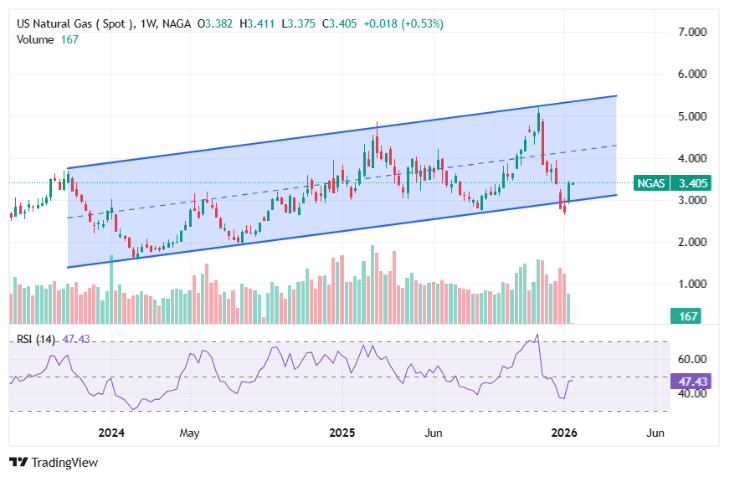
The chart below displays the weekly price action of US Natural Gas (Spot), highlighting key technical levels and indicators. The chart pattern shows an ascending channel since the beginning of 2024.
Over the past year, the price has traded sideways from mid-2023 lows, showing significant volatility. The chart identifies key resistance levels around the mid-range of the channel around $4, and the upper boundaries at $5. The key support level is the channel’s lower band at $3, retested at the beginning of 2026. A break below this support should send Gas prices toward the $2 level, which is considered very unlikely from a fundamental perspective. Though such a sell-off should be short-lived and a buy-the-dip opportunity.
NGAS technical analysis suggests the price should trade between the $3 support and $4-$4.2 mid-range of the channel during the next months, in line with the latest natural gas price predictions for 2026. The 50-week Moving Average is the first resistance around $3.7. The highest NGAS price target is above $5, the upper band of the channel, which aligns with the most bullish natural gas forecasts published by Morgan Stanley and EIA’s 2027 price prediction.
Past performance is not a reliable indicator of future results. All historical data, including but not limited to returns, volatility, and other performance metrics, should not be construed as a guarantee of future performance.
Visit our free trading courses
Natural Gas Price Predictions 2026
Major institutions forecast Henry Hub prices averaging $3.50–$5.00/MMBtu in 2026 amid LNG-driven tightening. A sell-off below $3 is seen as very unlikely or just temporary. A consolidation around $4 is the most anticipated development.
EIA Natural Gas Outlook: $3.50/MMBtu in 2026
The U.S. Energy Information Administration's latest STEO forecasts Henry Hub spot prices to average $3.50/MMBtu in 2026, a slight 2% decline from late 2025 levels, before surging 33% to $4.60/MMBtu in 2027. Quarterly breakdown: Q1 $3.70/MMBtu, Q2 $3.50, Q3 $3.40, Q4 $4.10/MMBtu, reflecting initial supply cushion from high storage (~3,300 Bcf end-injection) and flat production (~104 Bcf/d) matching demand growth, then tightening as LNG exports jump 1.3 Bcf/d to 14.8 Bcf/d and power sector demand (AI/data centers) adds pressure.
Storage ends 2025-26 winter at ~2,000 Bcf (9% above 5-year average), but 2027 sees deficits amid +2.5 Bcf/d demand vs. +0.9 Bcf/d supply—downward revisions from October ($3.94/MMBtu) due to enhanced production and milder power demand assumptions.
Morgan Stanley Natural Gas Forecast: $5/MMBtu in 2026
Morgan Stanley forecasts Henry Hub natural gas prices to surge above $5 per million British thermal units (MMBtu) in 2026, significantly higher than consensus estimates of $3.50-4.00/MMBtu, driven by a sharply tighter supply-demand balance as U.S. LNG exports and power-sector demand outpace subdued production growth. Analysts expect inventories to exit October 2025 at ~3.97 trillion cubic feet (5% above normal) but tighten dramatically through winter into 2026, creating storage deficits under normal weather—exacerbated by record LNG feedgas flows (16.5 Bcf/d in Oct 2025) from new projects like Plaquemines and Golden Pass, plus AI/data center power burns rising 2-3 Bcf/d cumulatively.
On the supply side, production trends lower at ~106-107 Bcf/d (down 1 Bcf/d from September peaks), with Haynesville shale declines and gas rig counts still insufficient despite edging up by four rigs—leaving "little spare capacity" as LNG capacity nears 20 Bcf/d. Weather emerges as the key swing factor: normal winters re-emerge deficits pushing prices >$5/MMBtu in H1 2026, while colder snaps amplify upside; Morgan Stanley reiterated this bullish $5 target as recently as December 2025 amid a 60% price rally since mid-October, contrasting bearish oil outlooks.
Fitch Ratings Natural Gas Forecast: $4.1 in 2026
Fitch Ratings forecasts $4.10/MMBtu for 2026, citing tighter balances from U.S. LNG capacity additions (Plaquemines/Golden Pass) offsetting flat production (~104 Bcf/d), with Europe/Asia demand sustaining a floor above EIA consensus [conversation context].
AI-based Natural Gas Forecasts 2026
Trading Economics forecasts Henry Hub to average $3.80/MMBtu in 2026, up from $3.23 in late 2025, based on historical trends showing LNG export growth and winter demand pulling prices from recent lows toward a $4+ equilibrium amid storage normalization.
Wallet Investor forecast $4.25/MMBtu annual average, with Q4 peak at $4.80/MMBtu, driven by algorithmic models factoring AI data center power surges (0.5 Bcf/d) and colder winters eroding high inventories.
Natural Gas Forecast for the Next 5 Years and beyond (2030-2050)
According to the EIA long-term forecast, Henry Hub reaches $3.80/MMBtu by 2030, climbing to $4.20/MMBtu by 2040 and $4.95/MMBtu by 2050, reflecting LNG export growth to 20+ Bcf/d offsetting pressure from renewable energy, while production rises modestly.
Deloitte forecasts $5.40/MMBtu in 2030, and $6.35/MMBtu by 2040, driven by sustained global LNG demand from Asia/Europe and U.S. data center power needs outpacing supply growth.
It's important to note that these forecasts are subject to significant uncertainty due to factors such as technological advancements, policy changes, and shifts in global energy demand. The ongoing energy transition and potential geopolitical developments could substantially impact natural gas prices in the coming decades.
When looking for future gas price predictions and attempting to assess the long-term outlook for natural gas prices, bear in mind that analysts’ forecasts can be wrong. Analysts’ projections are based on making fundamental and technical studies of the asset’s performance, but past performance never guarantees future results.
Always do your own research and remember that your decision to trade depends on your attitude to risk, your expertise in this market, the spread of your investment portfolio, and how comfortable you feel about losing money. Never invest more money than you can afford to lose.
Natural Gas Historical Performance
Natural gas prices soared from the second half of 2020 to the third quarter of 2022, owing to rising post-COVID-19 demand and concerns about Russia’s supply after it invaded Ukraine in February 2022.
In the fourth quarter of 2021, uncertainties regarding Russia’s supply bolstered the price rally, according to Cedigaz. Europe’s natural gas price reached its highest price for 2021 at €187/MWh on 21 December, before retreating to €70 on the last day of 2021.
Dutch Title Transfer Facility (TTF), the European gas price benchmark futures, rose almost 268% in 2021, while JKM rose 113%. US natural gas prices increased by almost 47% in 2021.
Global natural gas prices tumbled in the second half of 2022, from the heights reached in August.
US natural gas price began 2023 at $4.38, having fallen from a 14-year high of $9.85 per metric million British thermal units (MMBtu) on 29 August.
The recent Natural Gas price action started a base building after hitting seven-month highs around $2. Following this reversal pattern, natural gas reached an 8-month high at the beginning of Q4 2023.
The surplus at the start of winter and a mild winter and the seasonality sent the natural gas prices to the lowest levels since 2020, close to the $1.5 mark.
Following the natural gas supply shock of 2022 and a gradual rebalancing in 2023, gas markets moved to more pronounced growth in the first half of 2024, trading above $3 again, before falling to $2 at the beginning of Q3.
Other price predictions:
- Oil Forecast & Price Predictions 2026
- Gold Forecast & Price Predictions 2026
- Dow Jones Forecast & Price Predictions 2026
- Nasdaq-100 Forecast & Price Predictions 2026
- EurUsd Forecast & Price Predictions 2026
- Turkish Lira Forecast & Price Predictions 2026
- British Pound Forecast & Price Predictions 2026
- Silver Forecast & Price Predictions 2026
- IBEX 35 Forecast & Price Predictions 2026
Sources:




The present domain / website, NAGA.eu is owned by Naga Technology GmbH, however is independently and exclusively operated by Axon Securities S.A., an AEPEY which is authorised and regulated by the Hellenic Capital Market Commission (HCMC) under licence No. 7/560/02.09.2010 and with registered address 48 Stadiou Street, 105 64 Athens, Greece.
NAGA is a trade name and trademark under the NAGA Group AG, a German based FinTech company publicly listed on the Frankfurt Stock Exchange | WKN: A161NR | ISIN: DE000A161NR7. Exclusive rights for the use of the said trade name and trademark, in the territory of Greece, are exclusively granted to Axon Securities S.A. In this respect and for the avoidance of doubt, any references in the present domain to "NAGA" refer just to the brand/trade name/trademark, the NAGA Platform or account and not to any specific company under NAGA Group of companies.
RESTRICTED JURISDICTIONS:With regards to the current website, Axon Securities S.A. offers services to Greek residents. Axon Securities S.A does not provide investment and ancillary services in the territories of third countries including Japan, Canada and the USA. For further details please refer to our Terms & Conditions.
HIGH RISK INVESTMENT WARNING:CFDs are complex instruments and come with a high risk of losing money rapidly due to leverage. Between 74-89% of retail investor accounts lose money when trading CFDs. You should consider whether you understand how CFDs work and whether you can afford to take the high risk of losing your money.
Trading through an online platform carries additional risks. Refer to our Regulation section here.