
- Home
- Blog
- Forecast and Price Predictions
- IBEX 35 Price Analysis & Forecast for 2026
IBEX 35 Price Analysis & Forecast for 2026

The IBEX 35, Spain's principal stock market index, continues a strong positive trajectory into early 2026. As of January 15, 2026, the index stands at approximately 17,600 points, reflecting an over 2% growth since the start of the year. It closed 2025 at around 17,308 points, delivering a record annual gain of 49.27%, its best performance since 1993.
The index started 2025 at 11,610.9 points, building on a solid 15% rise in 2024. This propelled the IBEX 35 to double-digit returns, outperforming many European peers and solidifying its status as one of the continent's top markets. Sectors like banking, energy, and tourism drove the surge amid favorable global conditions.
Analysts forecast a bullish continuation, with averages above 16,000 points mid-year and potential highs near 22,000 by the end of the year. Factors like Spain's economic resilience, banking strength, and global trends support optimism, although risks from policy shifts and volatility persist.
Key IBEX 35 Forecast & Price Predictions - Summary
- IBEX 35 forecast Q1 2026: Experts forecast the IBEX 35 index to continue its upward trajectory into Q1 2026, building on recent record highs around 17,800 points amid Spanish economic growth and supportive global conditions.
- IBEX 35 price prediction 2026: Experts' analysis indicates upside potential in the banking and tourism sectors, IBEX 35 potentially benefiting from broader European stock bullishness for 2026, with some forecasts pointing to 19,000 by the end of the year.
- IBEX 35 price prediction for the next 5 years: Singular Bank and GovCapital forecast IBEX 35 at 18,000-20,000+ points by 2027, with Traders Union estimating 18,538 by end-2027 and 18,249 by end-2028, supported by earnings growth of 2-3% annually. Longer-term views from Traders Union predict 18,940 points by end-2029, dipping slightly to 17,390 by end-2030, then recovering to 18,509 points by end-2031.
With NAGA.com, you can trade the IBEX 35 index (ES35) through CFDs if you want to speculate on price movements or invest in IBEX 35 stocks and ETFs.
IBEX 35 Forecast 2026 - Fundamental Analysis
IBEX 35 ranks as one of Europe's more affordable markets, though updated price-to-earnings (P/E) data for early 2026 remains around historical averages near 13-14, based on recent trends.
So, what drove the 20254 momentum, and what's the outlook for 20265? Let's break it down.
- Economic growth: Spain's economic expansion played a major role. The economy expanded by 2.9% in 2025, boosting corporate earnings across sectors amid resilient domestic demand and a strong labor market. Inflation eased to around 2.5% for the year, supported by lower energy costs and favorable base effects, which sustained consumer spending and revenue growth.
- Monetary policy: The European Central Bank's rate cuts improved market liquidity and reduced borrowing costs, benefiting Spanish banks like BBVA and CaixaBank through sustained net interest margins and stock gains. Banking sector performance remained robust despite global uncertainties.
- Energy sector performance: Renewable energy firms such as Solaria continued to attract investment amid Europe's sustainability push, bolstered by Spain's competitive energy costs from renewables and lower reliance on imports.
- Global Influences: Easing global inflation and solid data from major economies, including the U.S., enhanced investor confidence in international markets, including Spain. The IBEX 35 trades at a forward P/E of around 10.7, with projections for modest 2026 profit growth.
Building on this momentum, the IBEX 35 2026 outlook points to continued potential amid evolving global dynamics.
IBEX 35 Outlook 2026
Projections for Spain's GDP growth vary between 2.0% (according to CaixaBank Research) and 2.2% (official government estimate). This momentum stems from a surge in Next Generation EU funding reaching €17.5 billion at its peak, a 0.8% rise in population, fueling demographic tailwinds, and supportive monetary policies that could boost output by 0.3-0.6 percentage points. Unemployment should ease to about 9.7%, bolstering consumer spending alongside consistent job gains of roughly 2%.
Santander Research also forecasts 2.0% growth, pointing to Spain's edge over the eurozone thanks to strong tourism recovery and vibrant services sector. BBVA Research concurs, stressing 4.2% export expansion even amid rising imports, which bodes well for the IBEX 35 through improved bank profitability and renewable energy momentum.
Major drivers encompass EU-funded infrastructure projects and a solid jobs market, with a 40-60% chance of expansion landing between 1.5% and 2.9%. Potential headwinds include escalating trade frictions and the ECB's shift toward tighter policy.
Learn more about Fundamental Analysis
IBEX 35 Technical Analysis
The IBEX 35, Spain’s benchmark stock index, saw impressive gains in 2025, climbing almost 50% to end the year around 17,315 points, near all-time highs. Momentum carried forward from previous years, keeping the index above critical moving averages amid positive market drivers. A short-lived surge past 11,900 early on gave way to steady climbing later.
IBEX 35 2025 Performance Recap
IBEX 35 had a remarkable 2025 technical performance: a record-breaking year with around 50% gains, breaking all-time highs amid bullish trends.
- Support and Resistance areas: Entering 2025 near 11,610, following 2024's solid 15% rise, the index leaned on floors around 11,300-11,800 from late prior-year trading. Rallies mid-season punched through ceilings at 14,300 and 16,500, hitting a top close to 17,315, with pullbacks finding footing near 14,000. Swings stayed wide, as shown by elevated ATR values.
- Trading Indicators: Throughout 2025, IBEX 35 prices held comfortably over 50-day, 100-day, and 200-day averages, locking in the uptrend sparked by the 2023 50/100 EMA bullish cross. The RSI above 68, plus MACD and ADX, fueled the push.
- Chart Patterns: Weekly chart turned a long-term flag pattern into a straightforward climb, breaking past 16,500 cleanly. Shorter daily frames resolved broadening triangles to the upside, powering that year's sharp rise.
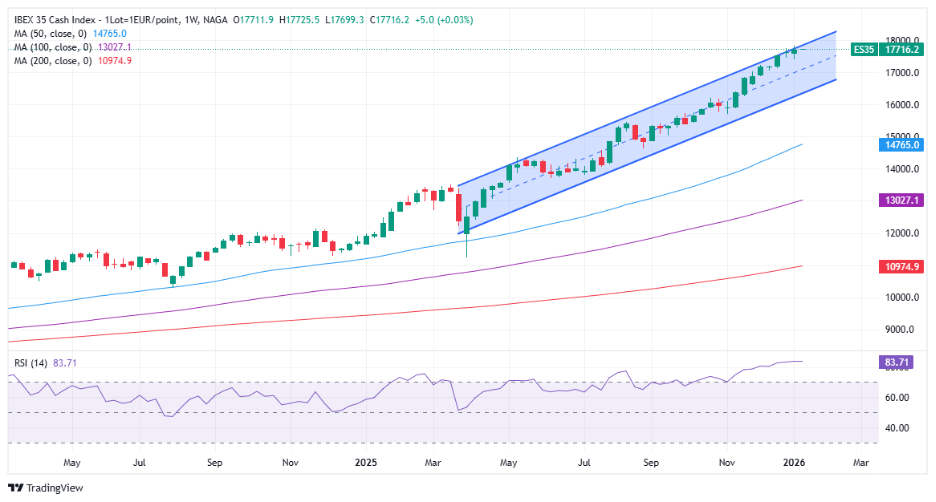
Past performance is not a reliable indicator of future results. All historical data, including but not limited to returns, volatility, and other performance metrics, should not be construed as a guarantee of future performance.
IBEX 35 2026 Technical Outlook
Hovering by 17,600 at mid-January 2026, buy signals dominate across moving averages and oscillators, hinting at more room to stay above 16,500. Traders may watch ceilings at 17,500-18,000, with drops possibly testing 15,000, if global jitters hit. Clearing fresh highs might eye 19,000, though stretched readings call for careful side-to-side action at first.
IBEX 35 components: Winners and losers
In 2025, Spain's IBEX 35 index surged nearly 50% to record levels around17,300 points, propelled mainly by banks that captured about 70% of those gains through high interest rates, high profits, appealing payouts, and mergers. Leading the pack were Santander with a 125% jump, Unicaja at 118%, BBVA up 112%, CaixaBank gaining 99%, and Bankinter ahead 85%, thriving on Spain's solid job market and tame inflation.
Travel giant IAG kept shining from tourism booms and defense spending ties, though it couldn't match the banks' pace. Retail leader Inditex added steady lifts as the nation's biggest firm, riding strong buyer demand despite the sector frenzy elsewhere.
Power and heavy industry names kept hurting from commodity swings and slow world factories, echoing 2024 woes for Solaria, Repsol, Enagás, Acciona Energía, and ArcelorMittal, with no big turnarounds noted. Luxury debutant Puig likely extended its post-IPO slump, struggling to win over skeptics.
Experts forecast Spain's economy to expand 2.0-2.2% in 2026, fueled by peak EU recovery funds worth €17.5 billion, population boosts adding 0.8%, and easy money policies lifting growth by 0.3-0.6 points. Joblessness should dip to 9.7% with 2% employment gains propping up spending.
Santander sees matching 2.0% GDP via tourism growth and service strength, outrunning the eurozone. BBVA highlights 4.2% export rises despite import drags, favoring IBEX banks and green energy plays.
EU cash for projects and a strong workforce back Traders Union's 19,176 end-2026 forecast, with banks eyeing 10-20% climbs on yields around 4.62% (watch ECB shifts, trade fights, and energy wobbles). Borja de Castro at Banco Big bets on steady finance, power, and building amid sticky inflation, aiding bank spreads.
IBEX Index Forecast 2026 – 2031
Spain's benchmark index has had an exciting run lately, and it's time to explore what could be next. Several algorithm-based forecasting services gave their estimates for the future value of the Spain 35 index.
Recent forecasts from experts indicate varied outlooks for the IBEX 35 index in 2026 and beyond, driven by economic recovery, banking sector strength, and global factors like interest rates and commodity prices.
The IBEX 35 currently trades around 17,600 points as of early 2026, up from its 2025 lows near 11,500-12,000, reflecting bullish momentum from financials and renewables.
Traders Union predicts an average price of €19,724 mid-year, reaching €22,251 by year-end, with monthly highs up to €17,759 in July. Trading Economics global macro model projections, and analysts' expectations forecast IBEX35 to be priced at 17225 by the end of this quarter and at 15819 in one year.
By 2027, GovCapital eyes mid-year averages near 45,193 points under optimistic scenarios, while Traders Union forecasts €20,135 mid-year. Projections to 2030 range from €25,960 (Traders Union end-2029) amid moderate geopolitical risks and tech growth.
Bullish drivers include banking consolidation and an ECB stable policy, though energy volatility and China's raw material demand pose risks. Technicals show uptrends past 16,500, targeting breakouts above 17,800.
IBEX 35 key components price prediction
The Spanish IBEX 35 remains a focal point for investors looking for insights into Spain's top companies. Let's explore the one-year forecasts for its key components.
Inditex (Industria de Diseño Textil, S.A.)
Based on 12 Wall Street analysts offering 12-month price targets for Inditex in the last 3 months, the average price target is €57.98, with a high forecast of €67.00 and a low forecast of €47.50. The average price target represents a 1.58% change from the last price of €57.08.
Iberdrola, S.A
Based on 11 Wall Street analysts offering 12-month price targets for Iberdrola in the last 3 months, the average price target is €17.56, with a high forecast of €20.95 and a low forecast of €14.50. The average price target represents a -3.79% change from the last price of €18.25.
BBVA (Banco Bilbao Vizcaya Argentaria, S.A.)
Based on 9 Wall Street analysts offering 12-month price targets for Banco Bilbao Vizcaya Argentaria in the last 3 months, the average price target is €20.96, with a high forecast of €24.50 and a low forecast of €18.50. The average price target represents a 2.49% change from the last price of €20.45.
CaixaBank, S.A
Based on 8 Wall Street analysts offering 12-month price targets for CAIXABANK in the last 3 months, the average price target is €10.22, with a high forecast of €11.55 and a low forecast of €8.75. The average price target represents a -2.85% change from the last price of €10.52.
Aena S.M.E. S.A
Based on 5 Wall Street analysts offering 12-month price targets for Aena SA in the last 3 months, the average price target is €24.27, with a high forecast of €28.30 and a low forecast of €18.04. The average price target represents a -1.46% change from the last price of €24.63.
Amadeus IT Group, S.A
Based on 5 Wall Street analysts offering 12-month price targets for Amadeus IT Group S.A in the last 3 months, the average price target is €75.20, with a high forecast of €87.00 and a low forecast of €70.00. The average price target represents a 19.21% change from the last price of €63.08.
Ferrovial, S.A Naturgy
Based on 9 Wall Street analysts offering 12-month price targets for Ferrovial in the last 3 months, the average price target is €64.60, with a high forecast of €75.30 and a low forecast of €58.50. The average price target represents a 11.49% change from the last price of €57.94.
Energy Group, S.A
Based on 4 Wall Street analysts offering 12-month price targets for Naturgy Energy Group, S.A. in the last 3 months, the average price target is €26.45, with a high forecast of €28.00 and a low forecast of €24.10. The average price target represents a 4.30% change from the last price of €25.36.
Telefónica, S.A
Based on 9 Wall Street analysts offering 12-month price targets for Telefonica in the last 3 months, the average price target is €3.65, with a high forecast of €3.90 and a low forecast of €2.90. The average price target represents a 8.96% change from the last price of €3.35.
In summary, these projections highlight significant potential gains across IBEX 35's top players, with Amadeus IT Group and Ferrovial showing upside potential. As always, market dynamics can shift quickly, so ongoing analysis and prudence are key.
Market Valuation and Performance
The Spanish stock market shows a fair valuation amid steady market cap expansion and solid earnings growth, though recent sector shifts highlight utilities facing headwinds while financials and staples gain ground for a balanced near-term view.
Current Market PE Ratio
At the beginning of 2026, the Spanish market's Price-to-Earnings (PE) ratio stands at 17.4x, with absolute PE at 17x, per the latest aggregation of listed firms. This level sits above historical norms from recent years, where averages hovered lower around 14-15x, placing it in a reasonably valued zone relative to growth. Market cap reached €1.1t, up notably from €570b in late 2022.
Past Earnings Growth
Spanish companies posted average annual earnings growth of around 10% over the past three years, fueled by rising totals from €42.5b in early 2023 to €65.4b today. Revenues climbed steadily at about 3% yearly in that span, from roughly €523b to €594b, pointing to improving margins amid economic recovery.
Learn more about EPS – Earnings Per Share
Sector PE Ratios
As of early 2026, sector-specific data appear reasonably valued compared to historical averages and European peers, with a relatively moderate overall P/E ratio around 13.8-14.1.
- Financials Sector: Trading at elevated multiples amid recent outperformance, with banks like BBVA and Santander driving gains through strong balance sheets.
- Utilities Sector: Under pressure with -2.77% recent change despite past leaders like Iberdrola. Valuations around PE 13-22x reflect shifting energy dynamics.
- Healthcare Sector: Holding steady at 0.60% recent performance, near its three-year average PE of about 37.5x, with analysts eyeing robust future gains.
This reflects stable but cautious valuations amid economic growth forecasts of about 2% for the year.
Forecasted Growth
Experts forecast the Spanish GDP to expand by 2.1-2.3% in 2026, supporting modest earnings advances for IBEX 35 companies around 2-3%, bolstered by high dividend yields. Compared to European peers, the market appears appealing, with banks and energy players like Repsol poised to contribute via solid returns.
In summary, the Spanish stock market exhibits a fair valuation with attractive past earnings growth, but modest earnings for the IBEX 35 companies.
High-value sectors like construction (3.8% growth from housing demand, low rates, EU funds) and ICT (4.2% via AI and digital infra) may lead, alongside pharma's 6-7% boost from innovation and Spain's biotech hub—despite U.S. trade risks. Manufacturing is expected to hit 2.6% on cheap energy prices; tourism steadies at 2.5% with market savings, and biotech/finance/consumer spending shine amid global AI trends. No contractions are expected, showing broad resilience.
Why is the IBEX 35 Index Important to Traders?
The IBEX 35 is an index of the 35 largest and most actively traded companies listed on the Spanish stock market. Established in 1992, the IBEX 35 serves as a national and international benchmark index, and the major indicator of Spain’s stock market performance.
The IBEX 35 (SP35) includes the largest and most liquid stocks in the local market, dominated by financial, real estate, oil and energy, and consumer goods companies. Some of the most well-known index constituents include the airline holding company IAG, airport operator AENA; utility companies Endesa and Iberdrola; steel and mining giant ArcelorMittal; and the leading banks Bankinter, BBVA, Bankia, Banco de Sabadell, Banco Santander, and CaixaBank.
Traders like to follow the IBEX 35 index because it can offer exposure to substantial market price volatility and significant day-to-day fluctuations. It also serves as the underlying asset for a wide range of derivative financial instruments. The IBEX 35 is known for its volume and volatility and attracts numerous day traders trying to profit from short-term price movements.
How Is IBEX 35 Calculated?
The IBEX 35 is calculated like many other popular stock indices. It uses a basket of 35 companies, and the changes in their stock prices to give a price for the index. It is euro-denominated, calculated in real-time during the trading hours of the Madrid Stock Exchange, and is weighted upon market capitalization.
The index is adjusted by a free float factor, meaning that the biggest constituents of the index have a higher percentage of the calculation, while smaller companies have a much smaller impact. Unlike most other major indices, the IBEX 35 has no weighting limit for a company, so therefore you should be aware of the makeup of the index and who the top 10 companies are. You should also check every six months when the index is reevaluated. This allows the trader to keep an eye on the biggest stocks that will be driving this market either higher or lower.
How to Invest in IBEX 35?
Investing in the IBEX 35 can be done through a multitude of instruments, and the one you choose will drastically affect the potential exposure and potential profit and loss of your positions. With NAGA.com, you can buy stocks and funds and trade CFDs on the most popular assets.
IBEX CFDs
The IBEX 35 is a way to gain exposure to the Spanish stock market without having to analyze the performance of individual companies. The Spanish IBEX 35 financial index typically provides traders with a high degree of liquidity, long trading hours, and tight spreads.
One of the most popular ways to trade the IBEX 35 index is with CFDs (contracts for difference). A contract for difference (CFD) is a contract between a trader and a broker, used to try and profit from the price difference between opening and closing the trade.
No matter whether you have a positive or negative view of the IBEX 35 evolution, you can speculate on price movements in either direction, with the profit or loss you make depending on the extent to which your IBEX 35 analysis and price forecast are correct.
Using CFDs to trade the IBEX 35 will allow you to go long or short in the market without having to deal with conventional exchanges. You trade directly with your CFD broker.
You’ll put down an initial deposit (called margin) to open a larger position, with profits and losses calculated on the full position size, not your deposit. Note that this means your profits or losses could outweigh your deposit amount.
CFDs are commission-free when you trade stock indices with NAGA.com, as charges are included in the spread.
IBEX 35 futures
The IBEX 35 is able to be traded via futures, which is a derivative of the index itself. Futures markets are on a regulated exchange and have standardized contract sizes. If you have a large enough account, it does present an opportunity as they are leveraged, but keep in mind that each contract can be expensive, and therefore for most retail traders, the CFD market offers a superior alternative.
One of the most common ways that people take advantage of IBEX 35 futures is by hedging their existing portfolios. For example, if you hold several Spanish stocks and are worried about a pullback, you may short the IBEX 35 futures contract to protect yourself on the downside.
Learn more about futures trading
IBEX 35 stocks
If you choose to replicate the IBEX 35 yourself, one Route that you can take is to simply buy stocks on the index. The IBEX 35 components and the weightings of your allocations would be the same as in the actual index, and the information about index components and their percentage weights is publicly available on several financial or investing websites.
The biggest difficulty is picking the right company and the fact that your risk is extremely concentrated. The buying of single stocks can fall victim to a company-specific problem while trading the entire index may help mitigate some of those risks.
While picking a specific company can lead to outsized gains, the reality is that it takes much more in the way of research to become good at it, something that most retail traders do not have the time to do, nor do they have access to all of the pertinent information easily.
It will take time and effort to construct the portfolio. It will also require a significant amount of transaction costs, as you will need to buy 35 individual stock orders to capture the IBEX 35. Commissions, in such a case, can really add up making it very costly to do.
Learn more about stock trading
IBEX ETFs
Another thing that we can take advantage of it is an ETF. Exchange Traded Funds (ETFs) are financial instruments that try to mimic the entire sector, index, or even economy by owning bits and pieces of various companies.
To invest in index funds either buy and sell an ETF just as you would do with any other security or speculate on the price movement of the underlying asset with CFD.
Buying shares in an index ETF is one of the most traditional ways for investors to gain access to the whole index. Index ETFs will either buy assets – e.g. stocks appearing in the index – or use derivative instruments like futures contracts to mimic the performance of the underlying.
Alternatively, open a position on an index ETF with a CFD and speculate on the collective performance of the Spain market's top companies and sectors. The most common form of stock index ETF is a weighted tracker, which mirrors the makeup of the index directly.
The Lyxor IBEX 35 (DR) UCITS ETF - Dist is a UCITS compliant exchange traded fund that aims to track the benchmark index IBEX 35 Net Return Index.
The iShares MSCI Spain ETF seeks to track the investment results of an index composed of Spanish equities.
History of the IBEX 35 Index
Maintained and regulated by the Spanish company Bolsas y Mercados Españoles (BME), the IBEX 35 Index was first published in its current form on 14 January 1992.
Historically, the IBEX 35 Spanish Stock Index reached an all-time high of 15, 945.70 in November 2007. The IBEX’s record low of 1, 873.58 happened in October 1992.
The list of other milestone dates for the Spanish major financial index includes the following:
- 14 January 1992 – The IBEX 35 was first published with a base value of 3,000 points
- October 1992 – The IBEX 35 reached its record low of 1873.58 points
- 2000 – 2007 – The years of good performance, boosted by domestic economic growth.
- November 2007 – The IBEX 35 hit its all-time high of 15945.70 points
- 2007-2009 – The period of high volatility, followed by the global financial crisis
- March 2009 – The IBEX 35 plunged to under 7,000
- 2010 – 2011 – The IBEX 35 is depressed, due to Spain’s economic problems and the Eurozone crisis
- June 2012 – The index stood at 6,065 points
- 2014 – 2017 – The IBEX 35 climbed back over the 10,000 - point mark
- 2017 – 2020 – The IBEX 35 was stable
- February – March 2022 – The IBEX 35 lost 40% following the COVID 19 threat
- March 2020 – June 2021 – The IBEX 35 recovered most of its losses and climbed close to 10,000 points
- June 2021 – October 2022 – The IBEX 35 plunged below 7,200 points
- October 2022 – Feb 2023 – The IBEX 35 rallied above the 9,500 price level
- Feb 2023 – October 2023 – The IBEX 35 consolidated between 9,500 and 8,500 price level
- October 2023 – December 2024 – The IBEX 35 has climbed to the 12,150 price level.
- January 2025 – Current – The IBEX 35 index rose to 17,695.7 from 11,610, which equates to an absolute rise of over 6,080 points and a percentage increase of roughly 52%.
Read also our monthly updates on FX, Commodities, and the Stock Market:
- Euro to Dollar forecast and price prediction 2026
- Pound to Dollar forecast and price prediction 2026
- USD to INR forecast 2026, 2027, 2030
- AED to INR forecast 2026, 2027, 2030
- SAR to INR forecast 2026, 2027, 2030
- Gold forecast and price prediction 2026
- Oil forecast and price prediction 2026
- Dow Jones forecast and price prediction 2026
- NASDAQ 100 Forecast & Price Predictions 2026
- Natural Gas forecast and price prediction 2026
- Silver forecast and price prediction 2026




The present domain / website, NAGA.eu is owned by Naga Technology GmbH, however is independently and exclusively operated by Axon Securities S.A., an AEPEY which is authorised and regulated by the Hellenic Capital Market Commission (HCMC) under licence No. 7/560/02.09.2010 and with registered address 48 Stadiou Street, 105 64 Athens, Greece.
NAGA is a trade name and trademark under the NAGA Group AG, a German based FinTech company publicly listed on the Frankfurt Stock Exchange | WKN: A161NR | ISIN: DE000A161NR7. Exclusive rights for the use of the said trade name and trademark, in the territory of Greece, are exclusively granted to Axon Securities S.A. In this respect and for the avoidance of doubt, any references in the present domain to "NAGA" refer just to the brand/trade name/trademark, the NAGA Platform or account and not to any specific company under NAGA Group of companies.
RESTRICTED JURISDICTIONS:With regards to the current website, Axon Securities S.A. offers services to Greek residents. Axon Securities S.A does not provide investment and ancillary services in the territories of third countries including Japan, Canada and the USA. For further details please refer to our Terms & Conditions.
HIGH RISK INVESTMENT WARNING:CFDs are complex instruments and come with a high risk of losing money rapidly due to leverage. Between 74-89% of retail investor accounts lose money when trading CFDs. You should consider whether you understand how CFDs work and whether you can afford to take the high risk of losing your money.
Trading through an online platform carries additional risks. Refer to our Regulation section here.